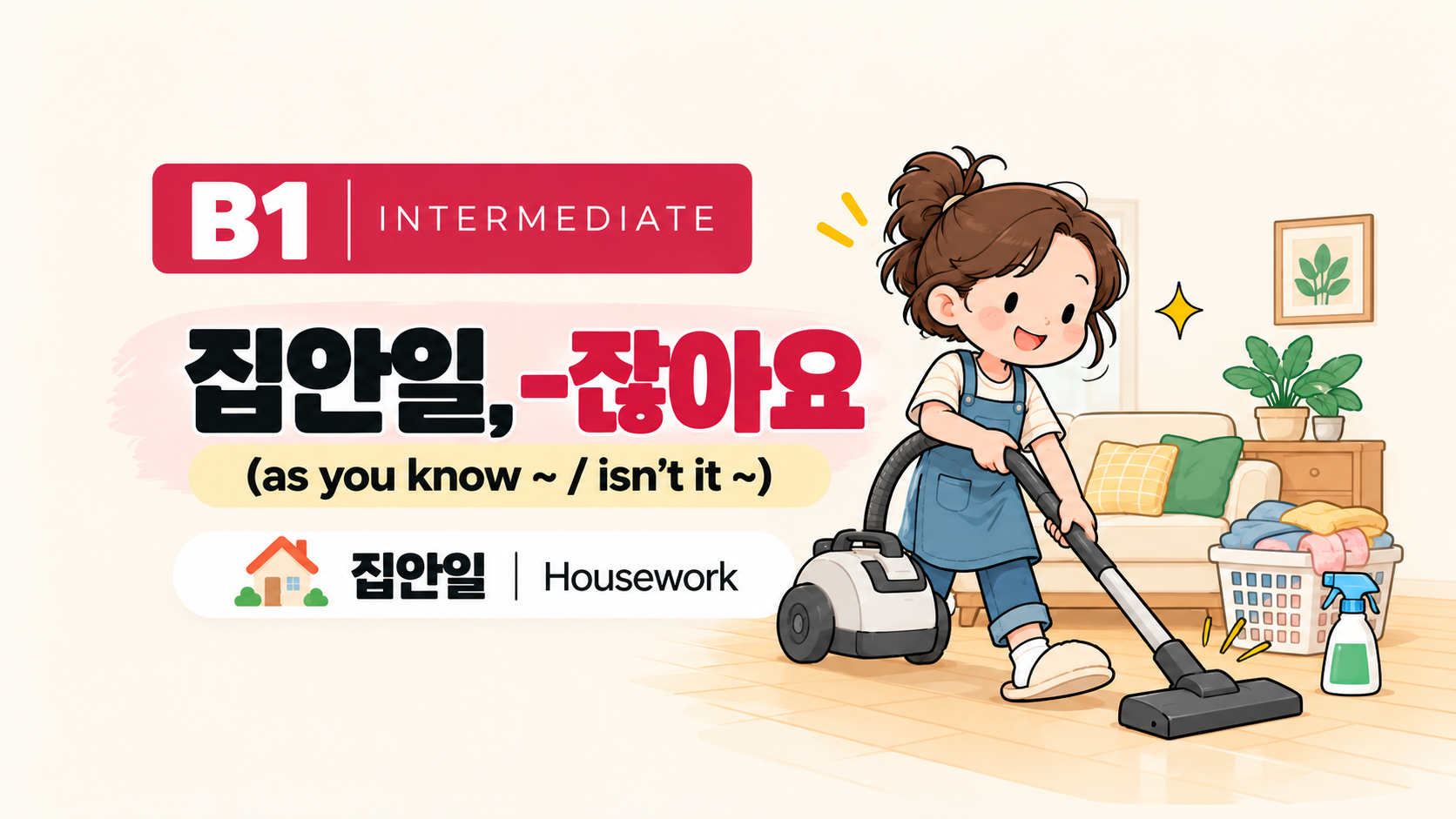
How do you talk about housework in Korean? In this lesson, you’ll learn 11 useful words and expressions for everyday chores, from doing the laundry to taking out the trash. You’ll also learn how to use -잖아요 to remind someone of a fact or mention something you expect them to know. Read the examples below, then use the PDF and video to keep practicing.
Vocabulary
| Korean | English |
|---|---|
| 청소기 | vacuum cleaner |
| 세탁기 | washing machine |
| 식기세척기 | dishwasher |
| 걸레 | cleaning cloth |
| 밥을 하다 | prepare a meal |
| (세탁기를) 돌리다 | run (the washing machine) |
| 빨래를 널다 | hang up the laundry |
| 빨래를 개다 | fold the laundry |
| 설거지를 하다 | do the dishes |
| 닦다 | wipe |
| 쓰레기를 내놓다 | put out the trash |
Grammar: -잖아요
-잖아요: Reminding Someone of a Fact
-잖아요 is used to remind the listener of a fact or mention something the speaker believes the listener already knows. Depending on the context, it can be translated as “you know” or “remember.”
Attach -잖아요 to a verb or adjective stem. With nouns, use N(이)잖아요: 이잖아요 after a consonant and 잖아요 after a vowel. After a vowel, 이잖아요 is also possible.
Example Sentences
A: 아들, 이제 일어나.
Son, it’s time to get up.
B: 조금만 더 잘게요. 오늘은 토요일이잖아요.
I’ll sleep a little longer. It’s Saturday today, you know.
A: 우리 어디에서 만났죠?
Where did we meet again?
B: 지난주에 모임에서 만났잖아요.
We met at a gathering last week, remember?
In the first dialogue, the son reminds his parent that it is Saturday. In the second, the speaker reminds the other person where they met.
Download the Practice PDF
Want to practice these words and expressions? Download the housework worksheet for vocabulary, grammar, and exercises. Talk about your daily chores and practice using -잖아요 in everyday conversations.
Watch the Video Lesson
Watch the lesson alongside this post, then come back to the vocabulary and example sentences whenever you need a quick review.